

Divar: How to reduce fake images in ads

The problem and the reason for its importance

In the Divar product, the image of 35% of the ads in the “property” category is not real, and about 10% of the ads do not have an image.
The idea of ​​the business strategy team is that this issue reduces the “trust” of users in Divar’s property category. In this way, the user of the wall has borne the cost of communicating with the ad owner to validate the ad and property images. We also know that, in general, the number of visits to advertisement images in the property section is lower than other sections of Divar, and most of the chats in this category are related to the topic of “requesting the main image of the property”.

Research

Interviews were arranged with three real estate agents and two non-real estate agent users (who have used property part of Divar). Because real estate agents are one of the main users of Divar property advertisement section and they are in contact with other persons such as buyers and sellers.

Questions:

  • Have you ever used fake photos in an ad? Why?
    (Clarifying the reason and motivation for this action and finding the target users)
  • Have you ever published an ad without a photo? Why?
    (Clarifying the reason and motivation for this action and finding the target users)
  • Have you ever come across an ad that used an fake photo?
    (Finding target users)

The general results obtained are as follows:

There are real estate agents who use fake photos.

The property that real estate agents post with fake photos, most of the time, does not exist at all, in fact, they publish ads to find different applicants and customers.

If the real estate agent does not have access to the photos of the property, in order not to lose time and publish the ad as quickly as possible, she/he either publishes the ad without photos or uses fake photos.

The owners do not use fake photos.

If the owners didn’t post a photo, it is most likely that they were either not familiar with the space and working with Divar and technology, or they didn’t have a photo available (tenant sitting or whatever) or they just didn’t feel like it.

Evaluation of research results

  • Real estate agents who use fake photos, do it with motive and not out of ignorance or lack of knowledge.
    (Need preventive solution)
  • Among the users who do not publish photos, most of them are owners who are beginners in using Divar or are not familiar with the digital space at all.
    (Need guidance and informative solution)
  • Some users who do not publish photos, it is intentional and or because of hurry or lack of access to photos of the property.

Current state of the product

The current product was reviewed to find weaknesses and opportunities

  • No preventive measure is taken for posting fake photos (only told to use real photos) and only stated conditions for posting photo and video.
  • The benefits of publishing photos are not mentioned and the novice user is not encouraged to publish photos.
  • In the violation report section, the possible options considered are few and general. (Not specified for property category.)

Competitive Analysis

In the Sheypoor application, when publishing an ad, it is mentioned that posting a photo for an ad increases the number of visits by 5 times.

Suggested solutions

For those who post fake photos

According to the research results that were reviewed earlier, we need preventive and encouraging solutions.

  • Basic checking of photos with artificial intelligence
    Using artificial intelligence, a preliminary review of the photos should be done: quality, name of the photo, checking with sources on the Internet, etc. (requires data and technical capabilities)
  • Verifying the ad and badge of the real property (optional)
    With this method, users trust the ads that have the real tag more, and the visits to these ads increase compared to other ads. Also, these ads are placed higher than other ads, which is useful for increasing visits. By doing this, by giving this information (increasing views) to the real estate agent when creating an ad, he can be motivated to increase the validity and views of his ads.
    One solution seems to me that it can be done with two methods, taking videos from all parts of the house as well as publishing photos from all parts of the house, which we compare the photos with the video and confirm if it matches. which can be done in two ways:
  1. Check videos and photos using artificial intelligence. Also, the user’s previous ads should be checked if he has not used the video and photos of the previous ads. Also it should check that he has not used the videos and photos of other users that have already been published.
  2. Check video and photos using human resources. Also, the user’s previous ads should be checked if he has not used the video and photos of the previous ads.

Problems and uncertainties:

This solution needs business data such as the average number of ads per day (related to all cities and provinces) as well as technical capabilities and facilities to estimate the need for human resources or the limitations and capabilities of artificial intelligence.

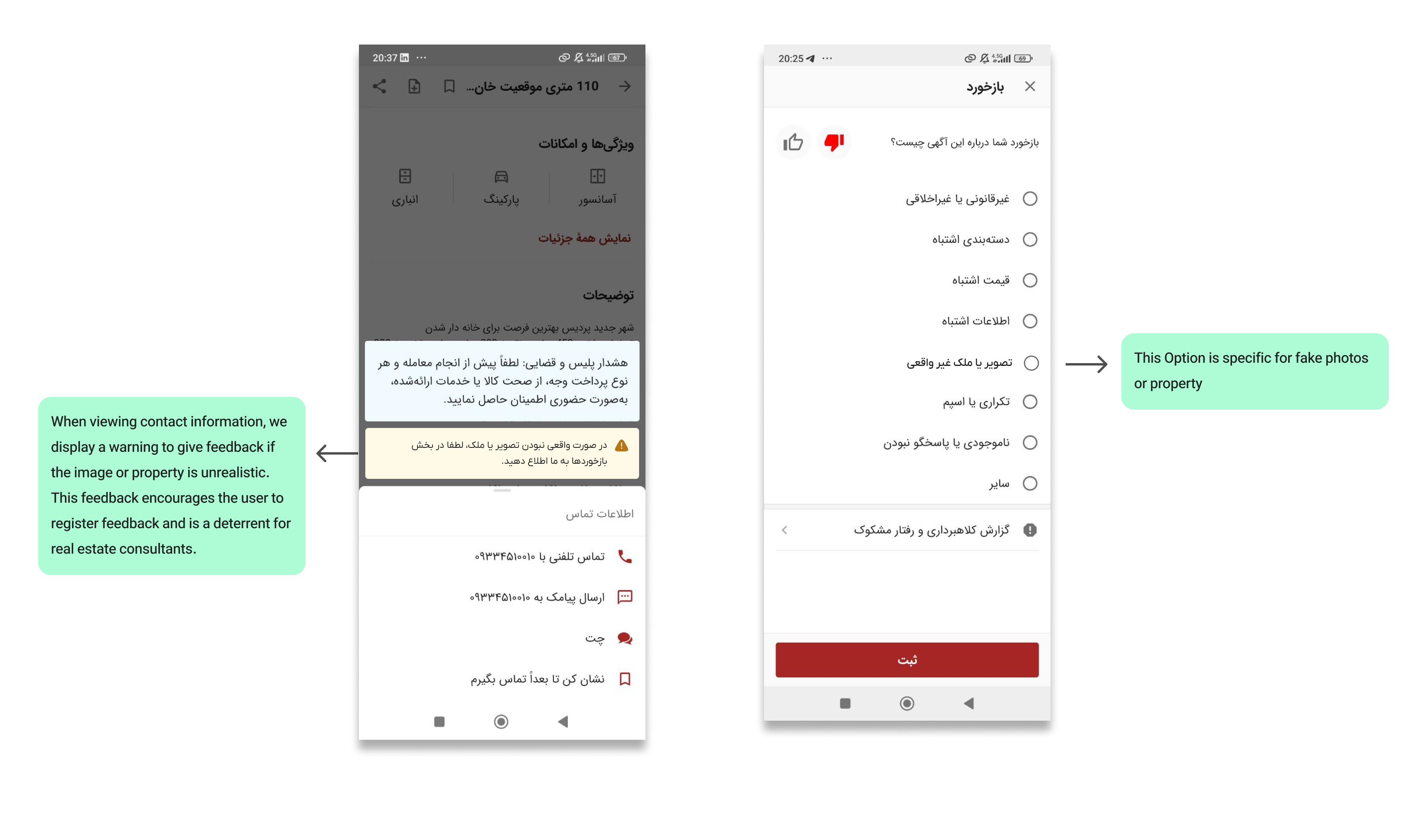
  • Getting better feedback from the user
    In the feedback section, we can add an option as a fake photo or property, and when giving contact information to the user, ask him to state in the feedback if the property or photo is unreal. (This has a deterrent effect for real estate agents to post unreal photos.) Now, if we have a number of feedbacks of this type for an ad, we will send a warning to the owner of the ad that we have received feedback, your ad is unreal and your ad will be removed, and if another ad of yours receive this feedback, you will not be able to publish an ad for a limited time.

Problems and uncertainties:

We must have a way to validate the feedback we receive. Because it is possible that competitor agents give negative feedback on purpose (this possibility exists on their current product and other kinds of feedbacks as well)

For those who do not post photos

For users who are beginners and do not take photos due to lack of skills or knowledge, we can increase their knowledge in two ways:
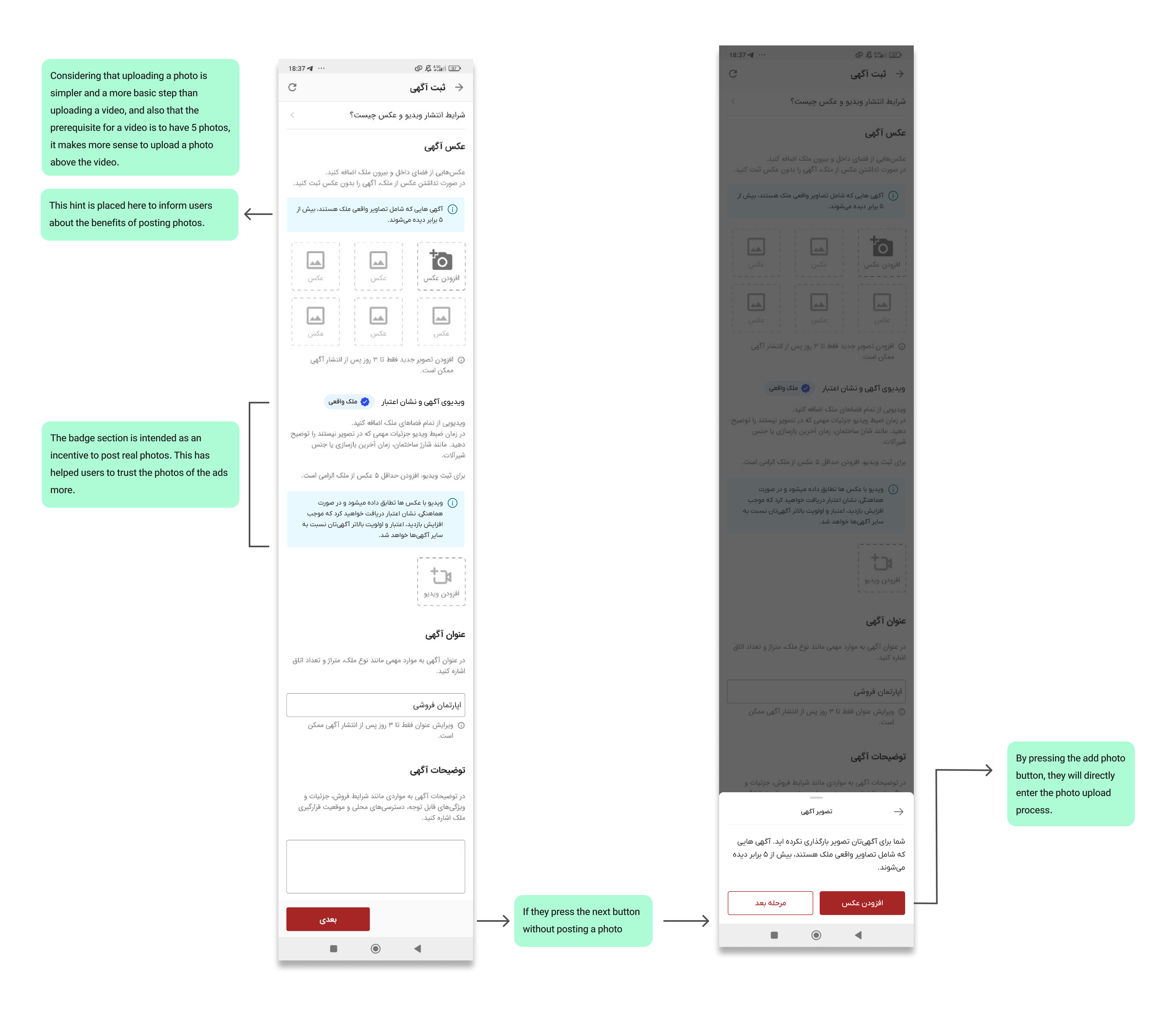
  • Hint of the benefits of posting photos
    When creating an ad, we display a hint that tells you the advantages of posting photos with ads.
  • Warning bottom sheet
    In the part where they are supposed to put photos of the ad, if they want to go to the next step without putting photos and press the “Next” button, a bottom sheet will be displayed as a confirmation, in which it is said that putting photos will increase visits. Are you sure not to upload photos?

Metrics and measuring the solutions

  • How much has the amount of classified ads that are not real decreased?
  • How much has the amount of real estate ads that don’t have photos decreased?
  • How much has the number of visits to advertisement images increased?
  • How much has the request for the main image of the property in chats decreased?